Why Marketing’s Future ‘Looks Pretty Amazing’

English, British
News Item Title
Why Marketing’s Future ‘Looks Pretty Amazing’
News Item Author Name
Forbes
News Item Published Date
News Item Summary

A recent Forbes article explores how AI is transforming search and the future of marketing. BrightEdge data featured in the article shows that ChatGPT now accounts for 95.1% of AI-driven website referral traffic, highlighting the rapid growth of AI as a discovery channel.

Jim Yu, Founder & CEO of BrightEdge, explains that marketers must look beyond traditional search rankings as AI platforms increasingly synthesize information from multiple sources to answer user queries. Brands need to ensure their content is accurate, authoritative, and discoverable across the sources AI uses to generate answers.

The article reinforces a growing shift in marketing from optimizing solely for search rankings to building AI visibility and earning citations and recommendations within AI-generated answers.

OpenAI Loyalty Settles In, Reshapes Advertising, Marketing Funnel

English, British
News Item Title
OpenAI Loyalty Settles In, Reshapes Advertising, Marketing Funnel
News Item Author Name
Media Post
News Item Published Date
News Item Summary

MediaPost reports that consumers are increasingly settling into preferred AI platforms, turning tools like ChatGPT into habitual destinations for research and purchasing. This is beginning to reshape the traditional marketing funnel and how advertisers think about referral traffic and media budgets.

BrightEdge data featured in the article shows that ChatGPT’s referral traffic to brands increased 101% from January to August 2026, reaching 95.1% of AI-generated referral traffic. ChatGPT now generates roughly 22× the combined AI referral share of Gemini, Claude and Perplexity.

ChatGPT now sends 95.1% of AI referral traffic to websites, BrightEdge says

English, British
News Item Title
ChatGPT now sends 95.1% of AI referral traffic to websites, BrightEdge says
News Item Author Name
The next web
News Item Published Date
News Item Summary

The Next Web highlights new BrightEdge data showing that ChatGPT generated 95.1% of AI-driven referral traffic to websites in August 2026, with its referral traffic growing 101% from January to August.

Jim Yu, BrightEdge CEO and Co-founder, notes that ChatGPT is not only gaining share but is also sending substantially more users to the web than earlier in the year. Overall AI referral traffic has grown about 73% in less than a year.

The story highlights the growing importance of AI-driven discovery and website referrals, as brands increasingly need to understand and optimize how they appear across AI platforms.

Insurance AI Citations: ChatGPT Cites Insurers on Branded Questions Only

Government domains hold the definitional and coverage citations. Branded and HR questions are still open to insurers.

Government domains and clinical references hold every link on definitional and coverage questions in a tracked Insurance prompt panel. An insurer's own domain is the cited source in one question type out of four. Two of the four carry ownable ground.

Almost every insurance content calendar has a line on it like what is short-term disability insurance. Is that line worth the money? We stayed inside one vertical and asked one question: where is there ground an insurer can actually hold.

We took a tracked Insurance prompt panel, grouped it by what the question actually asks, and read the cited domains and the mentioned brands for each group in AI Hyper Cube and AI Catalyst. Four groups came out of it. An insurer's own domain is the cited source in exactly one of them: branded queries, where the customer has already typed the company name.

The map, and the verdict for each question type

Three different owners hold the citation set for unbranded insurance questions, and which one shows up depends entirely on what the question asks. The fourth group belongs to the brand.

Question typeWho gets the linkWhyVerdict
Definitional and complianceGovernment domainsRegulatory authority holds itHold for the mention
Drug and procedure coverageOfficial and clinical referencesSpecialization, and narrowing furtherHold for the mention
Workplace and HR benefitsJob and HR platformsNo moat. Won on content qualityInvest. A real push
Branded and named queriesThe brand's own domainNobody else can hold itDefend. Best return

All four question types in this panel are listed here. Scope is one tracked panel over these weeks. Source: BrightEdge AI Hyper Cube and AI Catalyst. A tracked Insurance prompt panel, ChatGPT and Google AI Overviews, United States, one-month and 12-week comparisons to 20 September 2026.

Nobody is going to outrank the IRS on what a deductible is. That is not a content problem. No budget fixes it. The better question is where the ownable ground sits, and the data points at two places.

What we analyzed

We read two outcomes separately for the same prompts over the same weeks. A citation is the linked source under an answer. A mention is the brand named in the answer text. They are two different outcomes, counted separately, and they do not move together, which is why one visibility score hides the result.

Prompts were grouped by what the question asks. Definitional and compliance questions ask what something is or what the rules are. Workplace and HR benefits questions ask about retention, culture and employee cost. Drug and procedure coverage questions ask whether a specific treatment is covered. Branded questions name a company.

Data collected

FieldValue
CapabilityBrightEdge AI Hyper Cube and AI Catalyst
EnginesChatGPT and Google AI Overviews
VerticalInsurance
PanelAn anonymized panel of tracked Insurance prompts. Domains shown are the public sources appearing in AI answers. They do not identify the panel
MarketUnited States
PeriodOne-month and 12-week comparisons to 20 September 2026
MetricsShare of citations by domain, and mentioned-brand rank
Comparison basisSame tracked prompts at both dates, absolute shares, never indexed

Key finding

Measured. Definitional and compliance questions cannot be won, the what-is-a-deductible and what-does-the-law-require kind. Government domains hold 4 of the top 8 cited, up from a mixed pool of job sites, publishers and legal aggregators 12 weeks earlier. healthcare.gov rose from 19.2% to 40.4% of ChatGPT citations over one month. legalclarity.org fell from 8.8% to 3.4%. Both movements appear in the tracked panel and in a wider prompt set pulled for comparison.

Measured. ny.gov rose from 1.6% to 8.0% of citations on ChatGPT and from 23.6% to 29.3% on Google AI Overviews. This is the one movement in the analysis confirmed on both engines, which is why it carries the most weight here.

Measured. Branded questions run the other way entirely. When a query names the company, the company's own domain is the source cited. That held in every group checked, without exception.

Measured. Insurer domains hold a place in the mentioned top three for the vertical, alongside healthcare.gov and dol.gov, across the same weeks government domains take the citations.

We expected insurers to disappear from those two areas altogether. They did not: insurer domains hold a place in the mentioned top three in the same weeks government domains dominate the citation set, which means the link and the answer are two separate contests, and a brand can lose one while holding the other.

Inference, labeled as such. Tightly query-matched content in a closed question type appears to earn the mention even where it cannot earn the citation. The mention data is measured. The causal link to content is not, and it is the first thing to test.

Source: BrightEdge AI Hyper Cube and AI Catalyst. A tracked Insurance prompt panel, ChatGPT and Google AI Overviews, United States, one-month and 12-week comparisons to 20 September 2026.

Drug and procedure coverage is closing further

Drug and procedure coverage questions are the does-my-plan-cover-this-treatment kind. They moved further in the same direction over the month, and the split is clean enough to be worth staring at. Every domain gaining citation share is official or single-purpose. Every domain losing share is general-purpose consumer health content.

DomainShare of ChatGPT citationsDirection
drugs.com20.6%Gaining
nih.gov19.1%Gaining
medlineplus.gov6.5%Gaining
fda.gov4.4%Gaining
mayoclinic.org3.5%Losing
clevelandclinic.org3.2%Losing
healthline.com3.0%Losing
goodrx.com2.0%Losing
webmd.com1.4%Losing

These are the top movers in this panel, ranked within each direction. Scope is one tracked panel over these weeks. Source: BrightEdge AI Hyper Cube. A tracked Insurance prompt panel, ChatGPT, United States, one-month comparison to 20 September 2026.

No insurer appears among the top movers in either direction. That group is narrowing even for the non-insurers already inside it.

The one you already win: branded and named queries

Branded queries are already held and the work is defensive. The specific gap is content answering does [brand] cover [drug or procedure], in a format that answers the question directly on the brand's own site.

Winning here displaces nobody. Someone has already decided to ask about you, so the only job left is being the complete, well-structured answer when they arrive. That is a far smaller problem than out-authoring a federal agency. Treat it as defensive infrastructure and budget it that way.

One caution, because this is where budgets quietly leak. There is no observed spillover. Publishing more generic definitional content does not appear to build toward branded citations at all. The two draw from different source pools entirely.

The one worth buying into: workplace and HR questions

A separate cluster of prompts inside the same tracked group cites Indeed, Glassdoor, SHRM, Gallup, Workday, AIHR and BuiltIn. None of those domains overlap with the government cluster or the clinical cluster.

There is no regulatory moat here. Indeed and SHRM hold this ground because their content is good, which is the whole point: ground held on quality can be taken. For an insurer selling group or employee benefits, the HR lead searching retention benchmarks on a Tuesday afternoon is your buyer, one step before you normally meet them.

Competing here means publishing content that works as genuine HR guidance. Calculators, benchmarking data and retention research qualify. Product marketing carrying an HR label does not.

Where the weighting changes

The split holds across every question type checked in this panel, and the weighting does not. Definitional and compliance questions are the most closed, with 15 or more distinct government domains appearing across the group. Coverage questions are closing further. Workplace questions stay open on quality. Branded questions are held by the brand.

Which of the four dominates your prompt mix decides how hard to lean. Pull the split first. Setting a content budget without it is guessing with a spreadsheet open. This covers one vertical on a tracked Insurance prompt panel. Whether the same split by question type holds in other regulated categories is untested and worth checking separately.

What marketers need to know

  • Audit branded coverage content first. Someone is typing does [brand] cover [drug] into ChatGPT while you read this, and when a query names the company, the company's own domain is what gets cited. Go and check whether that page exists on your site in a format a machine can lift. Best return, least risk, shortest list of excuses.
  • Decide whether HR content is a business you want to be in. No regulatory moat sits behind it. You would be competing with Indeed, Glassdoor, SHRM and Gallup on content quality, which is winnable and expensive. Calculators, benchmarking data and retention research qualify. Product marketing with an HR label on it does not, and everyone can tell the difference.
  • Measure mentions separately from citations. Insurer domains hold a place in the mentioned top three while government domains take 4 of the top 8 cited. Keep tightly matched content in those two and report it as mention share in AI Catalyst, separately from citation share.
  • Stop budgeting generic content as AI-citation growth. Definitional content is up against regulatory authority. Coverage content is up against official health references sitting at 20.6% and 19.1%. An insurer closes neither gap. Keep the content, because it still earns organic traffic and on-site conversion, and move the line item out of the AI-citation column.
  • Google is still the channel to plan around. The ny.gov movement shows up on Google AI Overviews as well as ChatGPT, which is the tell. The canonical, specific content that earns organic visibility is the same content that gets a brand named in an AI answer, so it is built once and works on both surfaces.

How to check this for your own category

Path one. In AI Hyper Cube, pull the cited-domain list for your tracked prompts and group it by what the question asks. The owner changes by group, and that grouping is the whole exercise.

Path two. In AI Catalyst, read mention share beside citation share for the same weeks. Where the two diverge is where a single visibility score is hiding a result.

Path three. For the organic footprint underneath the same question set, use Data Cube X to size the space before you decide how hard to lean.

Frequently asked questions

What changed in how AI answers unbranded insurance questions?

The cited sources consolidated toward official domains. Government domains now hold 4 of the top 8 cited in the vertical. healthcare.gov alone went from 19.2% to 40.4% of ChatGPT citations in a month.

Can an insurer win the citation for definitional questions?

Plan as though the answer is no. 15 or more distinct government domains appear across that question group, and every week of the last twelve moved further toward them.

What is the difference between a citation and a mention?

A citation is the linked source under an answer. A mention is the brand named in the answer text. They are two different outcomes, counted separately, and they do not move together.

Which question type is worth the investment?

Branded and named queries, where the brand's own domain is already the cited source, and workplace and HR questions, which have no regulatory moat and are won on content quality.

Is this specific to ChatGPT?

Most of it is measured on ChatGPT. The ny.gov movement appears on Google AI Overviews as well, from 23.6% to 29.3%.

Does this hold outside Insurance?

This covers one vertical on a tracked Insurance prompt panel. Whether the same split by question type holds in other regulated categories is untested and worth checking separately.

Technical methodology

FieldValue
Data sourceBrightEdge AI Hyper Cube and AI Catalyst
EnginesChatGPT and Google AI Overviews
VerticalInsurance, tracked non-branded and branded prompts
MarketUnited States
PeriodOne-month and 12-week comparisons to 20 September 2026
MeasurementShare of citations by domain, and mentioned-brand rank, read separately
GroupingPrompts grouped by what the question asks
Comparison basisSame tracked prompts at both dates, absolute shares, never indexed
Corroborationhealthcare.gov, legalclarity.org and ny.gov each confirmed in two sources. ny.gov confirmed on both engines
PanelAn anonymized panel of tracked Insurance prompts. Domains shown are the public sources appearing in AI answers. They do not identify the panel
AnonymizationShares and ranks only. No prompt counts and no panel sizes
LimitsOne vertical on one tracked panel. Each engine is measured on its own prompt set, so engines are compared by direction only

Key takeaways

FindingThe number that proves it
An insurer's own domain is the cited source in one question type of fourBranded queries. The other three are held by government, job platforms and clinical references
Definitional questions are held by regulatory authorityGovernment domains hold 4 of the top 8 cited, up from a mixed pool over 12 weeks
The largest single domain shift is healthcare.gov19.2% to 40.4% of ChatGPT citations in one month
One government riser is confirmed on both enginesny.gov 1.6% to 8.0% on ChatGPT, 23.6% to 29.3% on Google AI Overviews
Coverage questions are closing furtherdrugs.com 20.6% and nih.gov 19.1% gaining, webmd.com 1.4% losing
Brands stay in the answer text where they lose the linkInsurer domains in the mentioned top three alongside healthcare.gov and dol.gov
Google is still the channel to plan aroundThe same specific, authoritative content supports organic visibility and gives AI systems stronger material to name the brand

Download the full report

Download the full breakdown, or see the rest of the Weekly AI & Search Insights series.

BrightEdge measures brand mentions and citations across ChatGPT, Google AI Overviews, Google AI Mode, Perplexity and Gemini. You can see which group your category's questions sit in before a competitor builds around it. Request a demo.


Download the Full Report

Download PDF

Click the button above to download the full report in PDF format.

Published on September 29, 2026

Subscribe for Weekly Updates

BrightEdge Data: ChatGPT Referral Traffic More Than Doubles in 2026, Reaching Record 95.1% Share of AI Traffic

BrightEdge Data: ChatGPT Referral Traffic More Than Doubles in 2026, Reaching Record 95.1% Share of AI Traffic

ChatGPT now accounts for roughly 22 times the combined AI referral share of Gemini, Claude and Perplexity.

SAN MATEO, Calif.—September 24, 2026—New data from BrightEdge shows ChatGPT is widening its lead as the dominant source of AI referral traffic to brands. Referral traffic from ChatGPT increased 101% from January to August this year, while its share of AI-generated referrals rose to a 2026 high of 95.1%.

The rebound picked up speed especially in August, when ChatGPT referral traffic jumped 36% from the previous month, its largest one-month increase of the year. Meanwhile, Gemini grew just 1%, while Claude declined 15% and Perplexity declined 17%.

The findings mark a sharp reversal from the beginning of the year. After competitive pressure prompted OpenAI CEO Sam Altman to declare a “code red” in December and refocus the company on improving ChatGPT, BrightEdge data initially showed users would easily switch to whichever AI Platforms was the most advanced and ChatGPT losing referral share. Now, eight months into 2026, that trend has reversed. ChatGPT is regaining share while also sending significantly more traffic to websites.

“Earlier this year, we were seeing a much more fluid AI market, where users were willing to move quickly between platforms. What stands out now is that ChatGPT isn’t simply taking that share back. It is also sending substantially more users to the web than it was at the beginning of the year,” said Jim Yu, CEO and co-founder of BrightEdge. “For marketers, that makes ChatGPT’s role much harder to ignore. The platforms shaping discovery are starting to have a measurable impact on where website traffic comes from.”

ChatGPT Widens the Gap

ChatGPT’s share of AI referral traffic reached a 2026 low of 89.5% in April, then climbed steadily over the following months to reach 95.1% in August. That recovery has left its closest AI competitors with only a small fraction of the referral market.

In August, Gemini accounted for 2.4% of AI referral traffic, followed by Perplexity at 1.1% and Claude at 0.8%. Together, the three platforms accounted for just 4.3%, meaning ChatGPT generated roughly 22 times their combined share of AI referral traffic.

Earlier this year, BrightEdge data pointed to a much more fluid market, with consumers moving quickly between AI platforms. The latest data suggests that volatility has not disappeared, but the gap in referral traffic is moving decisively in ChatGPT’s favor.

AI Referral Traffic Is Becoming a More Meaningful Discovery Channel

AI still represents a small portion of website referral traffic compared with traditional search, but its contribution is growing. Total referral traffic from AI platforms has grown roughly 73% in less than a year.

Traditional search remains the primary driver of website traffic, but the growth of AI referrals adds another layer to how consumers discover brands online. A growing number of users are beginning their journeys inside platforms like ChatGPT, Gemini and Perplexity, where an AI answer can determine which brands are considered and which websites ultimately receive the click.

For marketers, AI visibility is therefore becoming more than a brand-awareness question. It increasingly is a direct connection to customers. Brands need to understand not only where they rank in traditional search, but whether they appear in the AI answers, citations and recommendations that can now send consumers directly to their sites.

BrightEdge helps marketers manage visibility across both traditional and AI search in one platform. With BrightEdge AI Catalyst, brands can track how they appear across AI engines including ChatGPT, understand the prompts and journeys shaping discovery, and identify where content needs to be optimized to improve visibility and performance. AI Catalyst brings those insights together with BrightEdge’s search data and recommendations, giving marketers a connected view of how customers are finding and engaging with brands across search environments.

To explore the latest AI referral trends and see how BrightEdge helps brands measure and optimize performance across traditional and AI search, visit BrightEdge AI Pulse.

About BrightEdge

BrightEdge is the global leader in Enterprise SEO and AI-powered content performance. For more than 18 years, BrightEdge has helped thousands of brands and digital marketers, including 57% of the Fortune 500, transform online opportunities into measurable business results. Its industry-first platform integrates the most comprehensive dataset in search, combining insights from traditional SEO, digital media, social, and content with cutting-edge generative AI capabilities, including its deep learning engine DataMind and AI Catalyst platform. Trusted by enterprises, mid-market companies, and leading digital agencies, BrightEdge continues to set the standard for innovation in search and AI, enabling brands to win by becoming an integral part of the digital experience.

CONTACT: press@brightedge.com

Press Release Date

BrightEdge x Medable

How Medable Grew Keyword Rankings 9x and Built AI Overview Visibility with BrightEdge

9x
growth in top 10 keyword rankings for eCOA, from 15 to 140
219
AI Overview placements earned for eCOA since scaling up

Download the Case Study

BrightEdge AI Catalyst

Turn AI Search Into a Measurable Growth Channel 

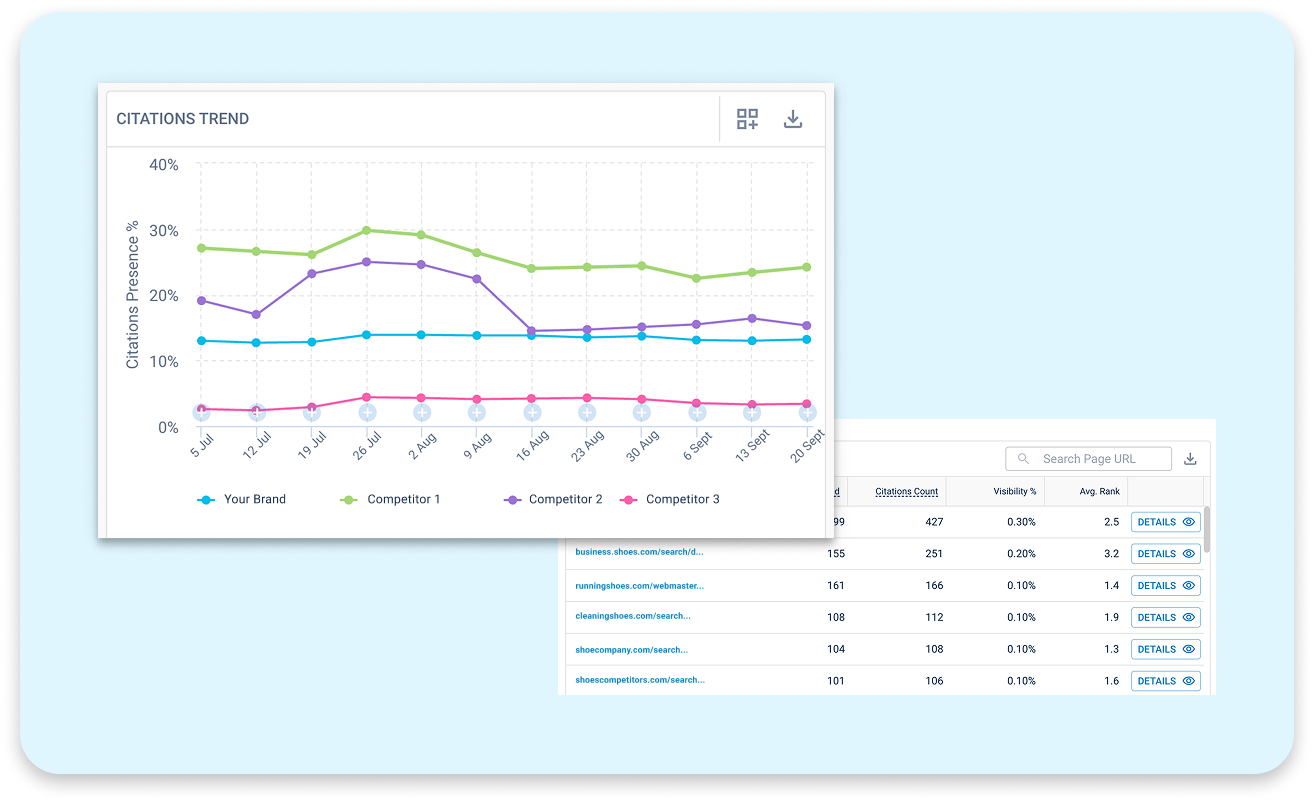
Your buyers ask questions to ChatGPT, Google AI Overviews and other AI platforms and act on the answers, often without ever visiting your website. Those AI Platforms decide whether you are mentioned, cited as a source and if you are described favorably or not. 

AI Catalyst is BrightEdge's intelligence layer for AI search. It turns those answers into measurable, competitive growth channels, tracking your presence across every major AI platform, benchmarking it against your competitors and converting any gaps into recommendations your team can act on. 

banner
1

Brand Presence & Authority

See Where Your Brand Stands Against Competitors in AI Search 

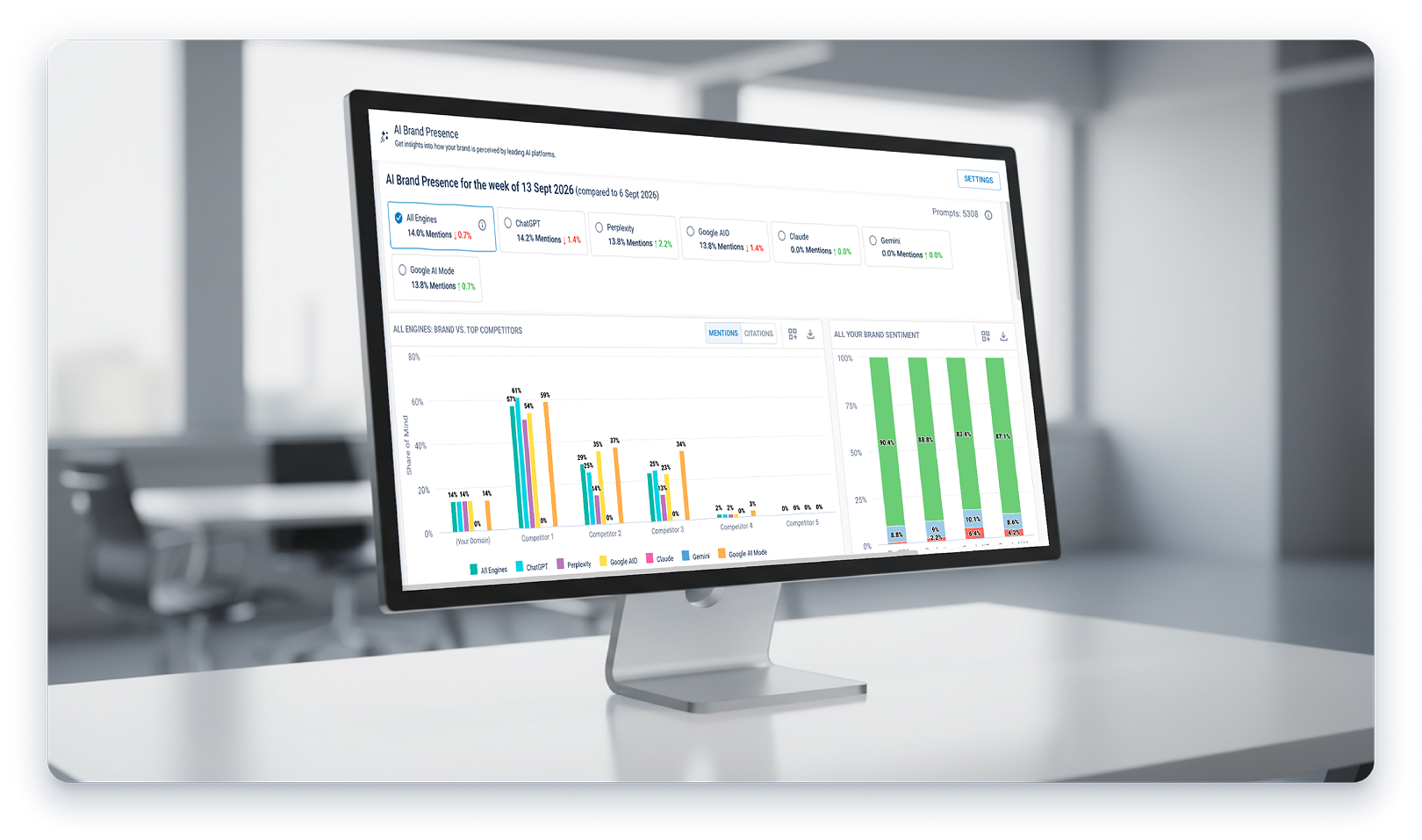
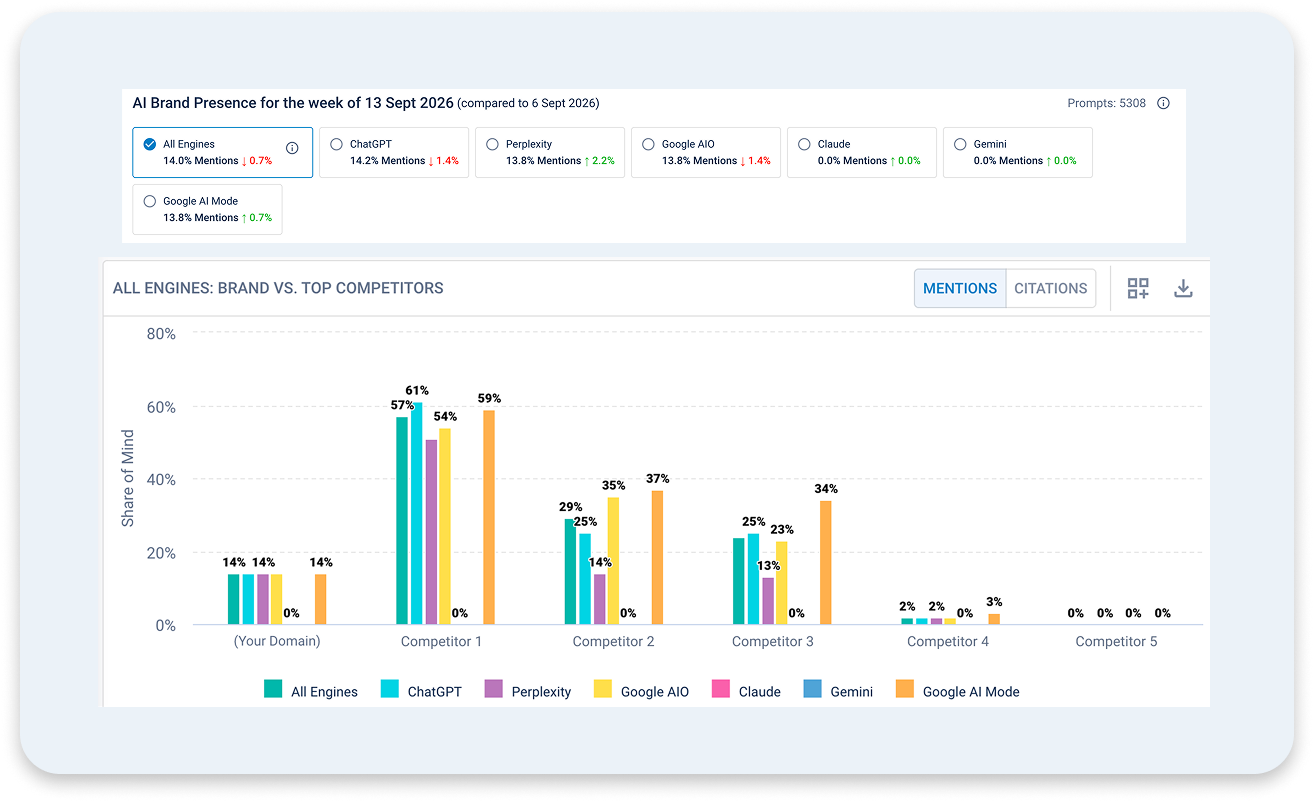
BrightEdge AI Catalyst tracks how often your brand is mentioned and cited across ChatGPT, Perplexity, Google AI Overviews, Google AI Mode, Gemini and other AI platforms, then benchmarks that presence against your competitors. Broken out by engine, you can see where each platform favors you and where it favors a competitor. You can watch how those gaps move over time and see whether you are gaining ground or losing it, broken into Mentions Presence and Citations Presence to show which one is driving the shift.

2

Brand Sentiment

Track How AI Platforms Describe Your Brand

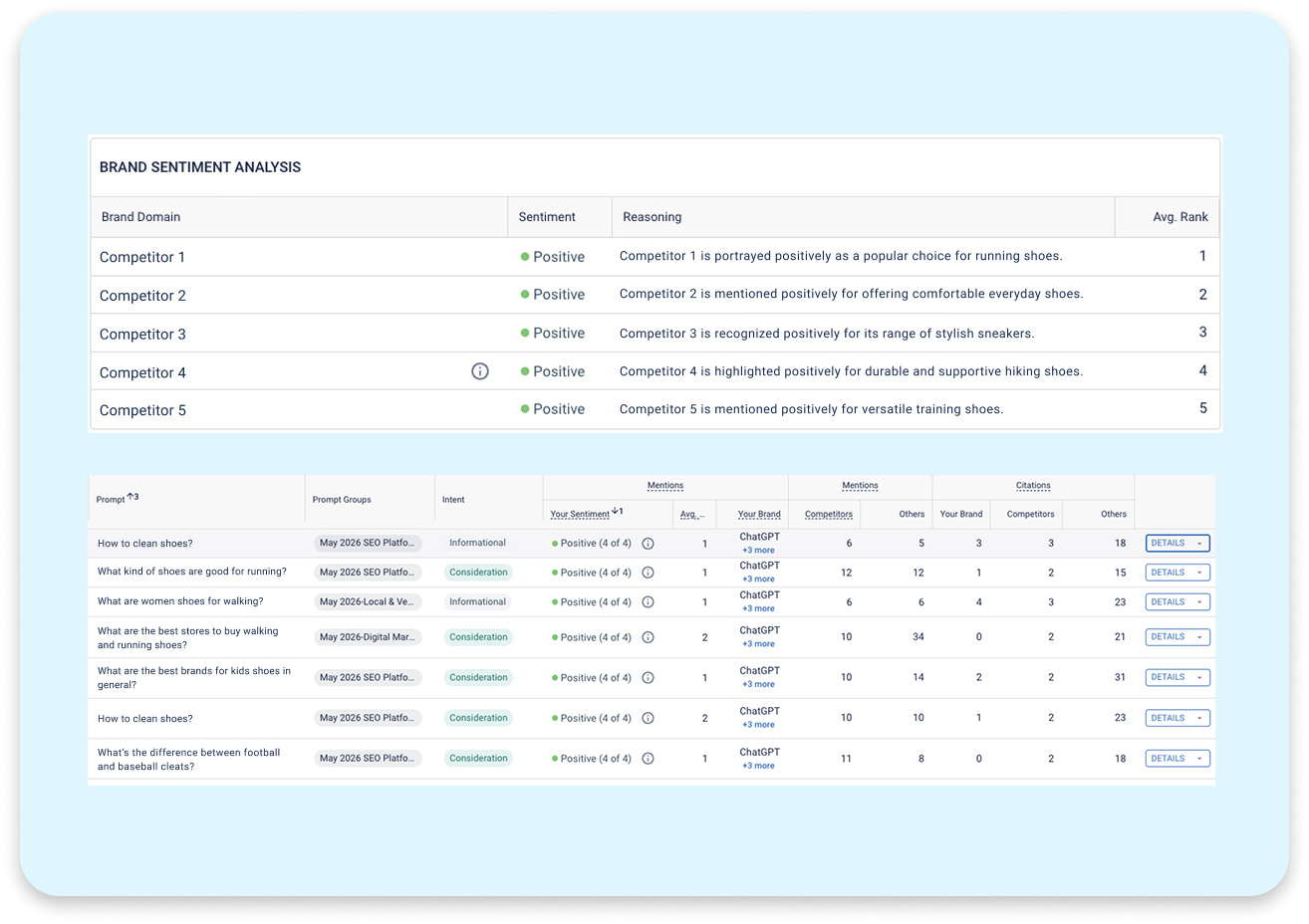
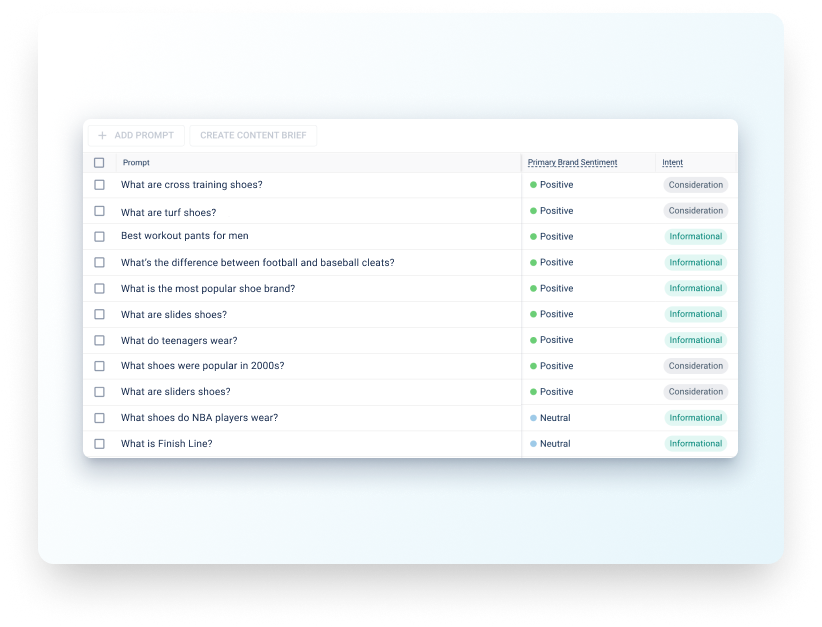
Every AI response that names your brand shapes how customers see you. BrightEdge AI Catalyst rates each one as Positive, Neutral or Negative, with the specific reasoning behind that rating for your brand and every tracked competitor. You can also test whether the answer changes depending on who is asking, a practitioner researching options or a decision maker ready to buy. When a competitor earns a more positive rating for the same question your buyers ask, you see the exact prompt and read the full AI response that earned it, turning a reputation concern into a specific piece of content you can go fix.

3

Prompt Intelligence

Find the Questions Buyers Are Asking AI Platforms

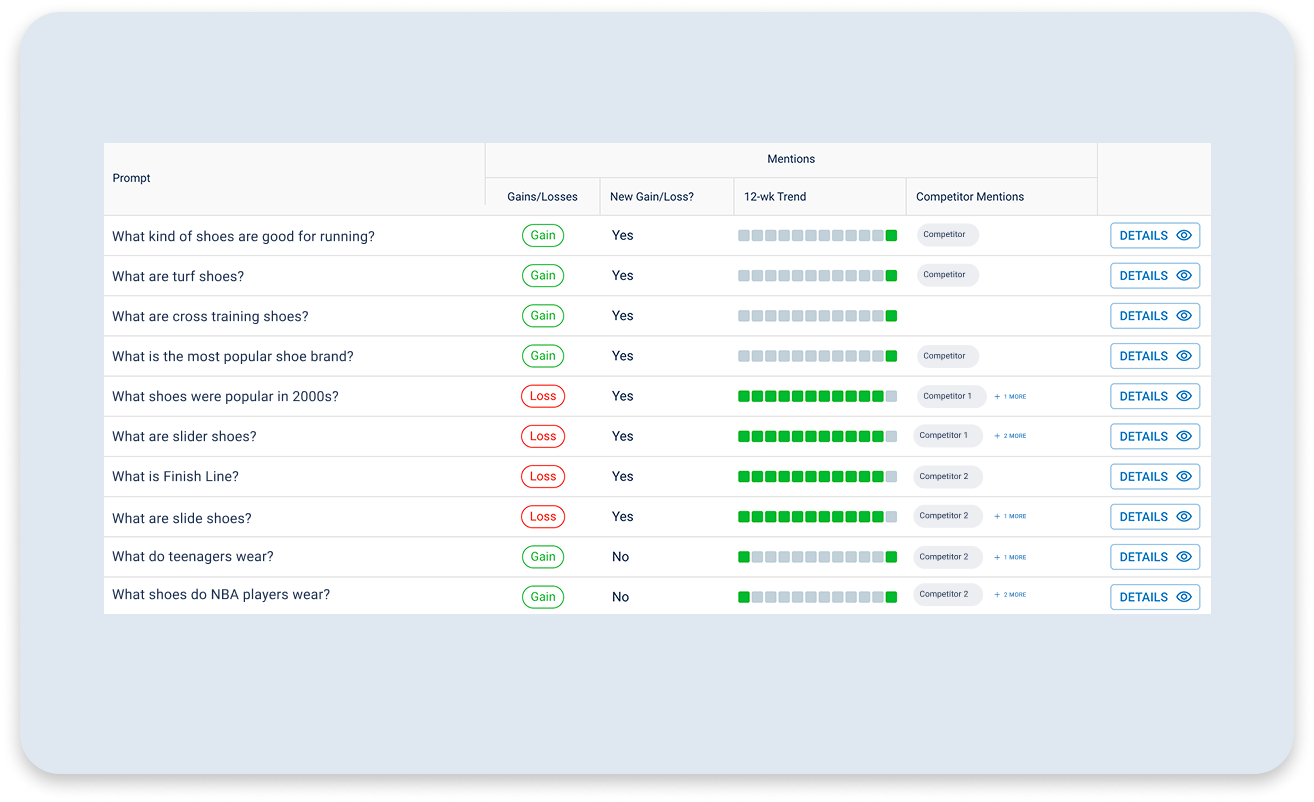
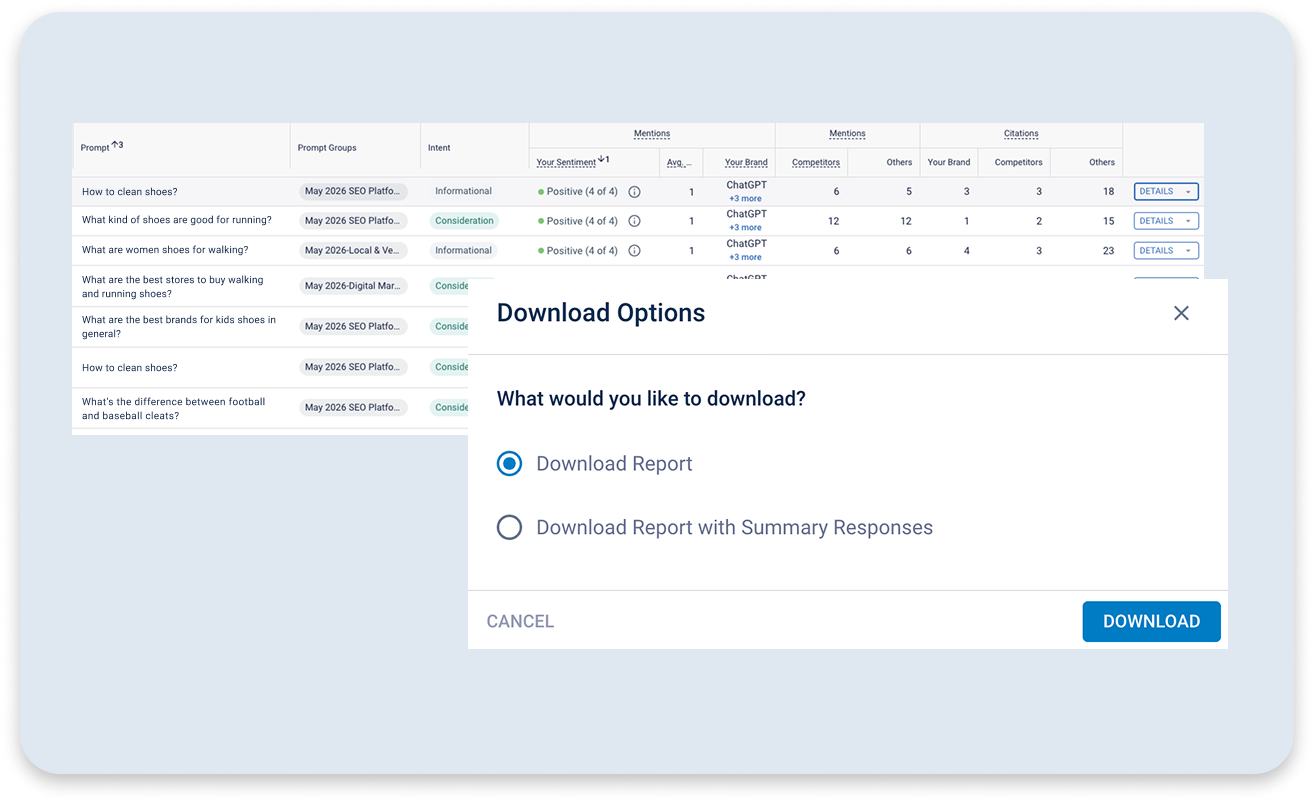
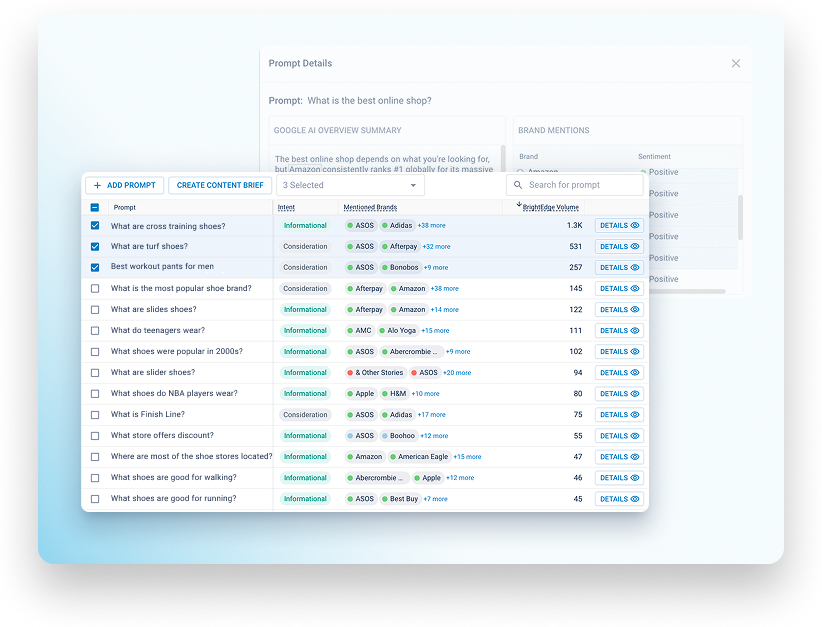
Buyers ask AI platforms longer, more conversational questions than the short keyword phrases they type into organic search. A buyer might type "best analytics platform" into Google, but ask an AI platform something closer to "which analytics platform fits a 30-person marketing team already juggling five other tools." BrightEdge AI Catalyst builds and tracks those prompts for you, mapped to the stage of the buyer journey, then flags the moment a competitor takes over an answer you used to own. That gives your team a working list of which AI conversations to act on next to win the answer back. 

4

AI Recommendations

Earn the Citations Your Competitors Currently Own

AI platforms are more likely to cite pages that answer questions more completely. AI Catalyst shows you which page holds that spot today, putting your page side by side with it on citation counts, ranking keywords and estimated traffic, and pinpointing where you fall behind on quality, depth and structure. It turns those gaps into a ready-made brief your team can act on the same day, and names the social platforms, publications and contributors earning citations on your topics, handing your outreach a specific name and a warm way in.

5

Team Reporting

Share the Numbers Your Whole Team Can Act On

Insight that stays with one person does not help the rest of your team. Every chart and table can be pinned to a BrightEdge dashboard that stays current as new data comes in, and annotated with notes on campaign launches, algorithm updates or competitive moves. That context travels with the numbers themselves. Export any chart as a PNG for a board deck, or any table to CSV for a deeper analysis.

See How Your Brand Shows Up
in AI Search 


Request a Demo

Frequently Asked Questions

 
Please reach out to your CSM or event_planning@brightedge.com for any questions/comments/suggestions.

The B2B Tech Shortlist Is Tightening Where Buyers Start

ChatGPT named 28% fewer brands per answer in B2B Tech in September 2026 than it did in March. The decline concentrates at the top of the funnel.

BrightEdge referral data shows AI search volume still climbing. Against that, a shorter list of brands per answer means each named slot is worth more than it was six months ago.

This edition covers the B2B Tech vertical. The panel holds the same non-branded prompts constant across two dates six months apart. Movement in the numbers reflects how ChatGPT answers changed. What was asked stayed the same. Usage and answer quality can both climb while the named list gets shorter. Measured in AI Catalyst.

What brand mentions measure, and what they do not

Mentions per answer counts how many distinct brands ChatGPT names in a single response, averaged across the tracked prompt set for a funnel stage. It is not citation volume, and it is not market share. A single answer can name many brands or very few, so the count moves independently of how many sources get cited for the same answer.

Source: BrightEdge AI Catalyst. A fixed panel of tracked non-branded B2B Tech prompts, ChatGPT engine, held constant across 15 March 2026 and 13 September 2026.

TermDefinition
Mentions per answerThe average number of distinct brands ChatGPT names in a single answer, for a given funnel stage.
ChangeThe difference in that average between the two dates.
Sum across brandsOne answer can name several brands, so this counts how many brands appear alongside each other in a single answer, separate from any measure of exclusive market share.

Where the list got shorter

Where a prompt sits in the buyer's journey now decides how short the list gets. The panel stayed fixed. The prompts stayed fixed. Only the answers changed. Every figure below covers prompts that held the same intent classification on both dates. On those prompts ChatGPT named 5.36 brands per answer in March against 3.87 in September, a 27.9% decline. The fall concentrates at the top of the funnel.

Figures are the fixed-cohort cut: every prompt that carried the same intent classification on both dates. Source: BrightEdge AI Catalyst. A fixed panel of tracked non-branded B2B Tech prompts, ChatGPT engine, held constant across 15 March 2026 and 13 September 2026.

Data collected

Funnel stageMar-26 avg. brands/answerSep-26 avg. brands/answerChange
All stages5.363.87-27.9%
Informational5.153.50-32.0%
Consideration8.216.39-22.1%
Transactional2.023.34Not read as a trend

Post Purchase carries too few prompts to read as a trend and is excluded. Transactional is printed above and held out of the conclusions below, for the reason given in its own section.

FieldValue
CapabilityBrightEdge AI Catalyst
EngineChatGPT
MarketUnited States
VerticalB2B Tech
PromptsTracked non-branded prompts only, matched exactly across both dates
Period15 March 2026 and 13 September 2026
MetricMentions per answer, the count of distinct brands named in one response
Comparison basisSame prompts both dates, absolute averages, never indexed
AnonymizationShares and averages only. No prompt counts and no panel sizes

The questions buyers start with got the most selective

Informational prompts are the broadest questions, such as what a technology is or how it works. They went from naming 5.15 brands per answer to 3.50, a 32.0% decline, the steepest fall of any stage.

Microsoft, Google, and Amazon lost the most ground, down 9.5, 6.7, and 6.4 points. A cluster of developer and data-infrastructure names lost ground alongside them: Apache, dbt, Snowflake, Elastic, and HashiCorp.

IBM gained the most, up 9.9 points. NIST.gov, TechTarget, FBI.gov, Cisco and FTC.gov gained too, so institutional and government sources moved up alongside a publisher. The expected publisher squeeze does not appear in this data.

Consideration became a shorter list

Consideration prompts are where someone is comparing named options, such as accounting software for a small business. They went from naming 8.21 brands per answer to 6.39, a 22.1% decline.

Google, Amazon, GitHub, Trend Micro, Apple, and GitLab lost the most ground, down 9.3, 6.1, 3.7, 3.3, 2.0, and 2.0 points.

Every brand gaining ground here is a single-purpose tool.

BrandMarch presenceSeptember presence
Zoho8.5%12.8%
Wave Apps2.8%5.7%
SAP3.5%5.7%
Squareup2.8%5.0%
Malwarebytes1.4%4.3%
ProtonVPN2.1%4.3%
NordVPN2.1%4.3%
Kubernetes.io2.1%4.3%
ServiceNow1.4%3.5%
ClickUp1.4%3.5%
ESET0.7%2.8%
Terraform.ioNot present2.1%

Why buying-intent prompts are held back

Transactional prompts are where someone is ready to buy. They moved differently over the same window. A third measurement point shows that movement reversing, so the stage is held out of this edition's conclusions until the full weekly series is in. Both figures are printed above, so the omission is visible.

Two dates can show a direction that a third date takes away. So we waited, and printed the figures anyway.

Everything else in this edition holds at every measurement point checked.

Mentions and citations do not always move together

The relationship between how many brands get named and how many sources get cited is not consistent across the funnel.

In Informational, citations per answer rose from 2.30 to 3.12 even as mentions fell. Fewer brands were named, and each was backed by more sources.

In Consideration, citations fell in step with mentions, from 5.70 to 3.25.

In Transactional, citations stayed close to flat, from 1.92 to 1.84, while mentions rose.

What marketers need to know

  1. Fight for the winnable Consideration prompts. Pull Consideration-intent prompts for your category in AI Catalyst or AI Hyper Cube, then check where you already show up. Every brand gaining ground here is a single-purpose tool. Find the use case your product owns, and build content that answers that exact question.
  2. Audit where you appear stage by stage. A single visibility score hides which stage you are missing from. Split your tracked prompts by intent and find the stage where you are absent, because being absent from a stage is a different fix from ranking low inside it.
  3. Hold your top-of-funnel investment. Awareness answers hold their value. They just got harder to win, and the goal there is now earning a place on a shorter list. Pull awareness prompts for your category in AI Catalyst. Identify one to three where you have a right to win but do not appear, then prioritize those.
  4. Google is still the channel to plan around. The canonical, specific content that earns organic visibility is also what gets a brand named in an AI answer. Build it once and it works on both. Re-run this funnel comparison quarterly, because funnel-stage presence keeps moving.

How to check this for your own brand

Path one. Open Mentions, filter to your tracked B2B Tech prompt groups, and split by funnel stage. Compare two dates six months apart to see whether your category shows the same shift. Do it in AI Catalyst.

Path two. In AI Hyper Cube, pull the mentioned-brand list for your category across funnel stages for the cross-engine, brand-anchored view.

One caveat. A category with very few Consideration or Transactional prompts will not show a clean trend either way. This check is most useful where your category has enough tracked prompts at each funnel stage to compare, as B2B Tech does here.

Frequently asked questions

What changed in how ChatGPT answers B2B Tech questions?

Over six months ChatGPT named fewer brands per answer, and the decline concentrated at the top of the funnel. Overall presence fell 27.9%, from 5.36 to 3.87 brands per answer.

Which funnel stage lost the most brand presence?

Informational, the broadest and earliest-stage questions, fell 32.0%, from 5.15 to 3.50 brands per answer.

What happened at the buying-intent stage?

Transactional moved differently and is not reported as a finding here. A third measurement point shows that movement reversing, so the stage is held until the full weekly series is complete.

Does this mean publishers are losing ground to owned content?

The data does not support it. TechTarget gained ground in Informational over the same period, and other major publishers stayed flat. That pattern does not carry a publisher-versus-owned-content story.

Is this specific to ChatGPT?

Yes. This measurement is ChatGPT only. Whether Google AI Overviews and AI Mode follow the same funnel-stage pattern is untested and worth checking separately.

How reliable is the funnel-stage classification?

About 15% of prompts were reclassified into a different intent stage between the two dates. Every figure in this edition uses the fixed cohort instead: only prompts that carried the same classification on both dates. Reclassification therefore cannot explain the result.

Technical methodology

Measurement: mentions per answer, the count of distinct brands named in a single ChatGPT response, averaged across the tracked prompt set for each funnel stage.

Panel: tracked non-branded B2B Tech prompts on the ChatGPT engine, matched exactly across 15 March 2026 and 13 September 2026. Every prompt is present in both periods.

Classification: each prompt is assigned a funnel stage by intent. About 15% of prompts were reclassified between the two dates. The headline figures use the fixed cohort, meaning only prompts that held the same stage on both dates.

Cross-check: the same comparison run across all prompts at each date's current classification gives a 25.1% overall decline, against 27.9% on the fixed cohort. Brand-level movements quoted here are computed on all prompts at each date.

Scope: ChatGPT only. Whether the same funnel-stage pattern holds on Google AI Overviews or AI Mode is untested. Google remains the larger channel and the one to plan around.

Key takeaways

FindingThe number that proves it
ChatGPT names fewer brands per B2B Tech answer overall5.36 to 3.87 brands per answer, a 27.9% decline
The decline concentrates where buyers startInformational fell 32.0%, Consideration fell 22.1%
Consideration's gainers are single-purpose toolsZoho rose from 8.5% to 12.8% presence, the largest gain in that stage
Mention volume and citation volume do not move togetherInformational citations rose from 2.30 to 3.12 per answer even as mentions fell
Government and standards sources gained, and so did one publisherNIST.gov up 8.1 points, TechTarget up 6.9 points
Google is still the channel to plan aroundThe content that earns organic visibility is what gets a brand named in an AI answer

Download the Full Report

Download PDF

Click the button above to download the full report in PDF format.

Published on September 21, 2026

Subscribe for Weekly Updates

🤖 AI-Powered Intelligence

The Enterprise Standard for AI Search Intelligence 

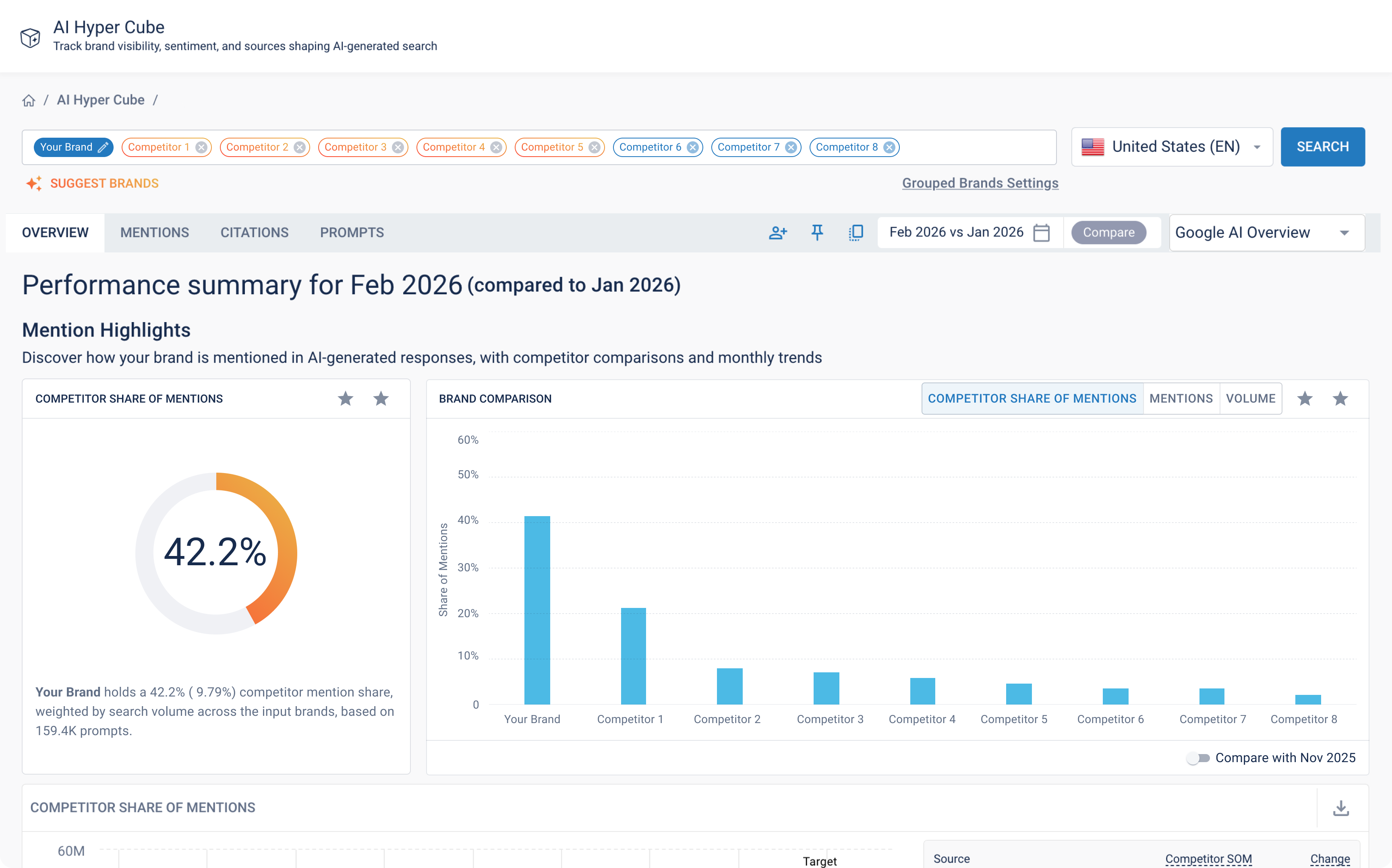
AI platforms like ChatGPT and AI Overviews are shaping brand preferences before customers ever reach your site. AI Hyper Cube turns that into competitive intelligence, making your brand's position visible, actionable and measurable: how you compare to competitors, and which of your pages already earn AI trust.

banner
1

Competitive Intelligence

Uncover the AI Conversations that Matter and the Brands Winning Them 

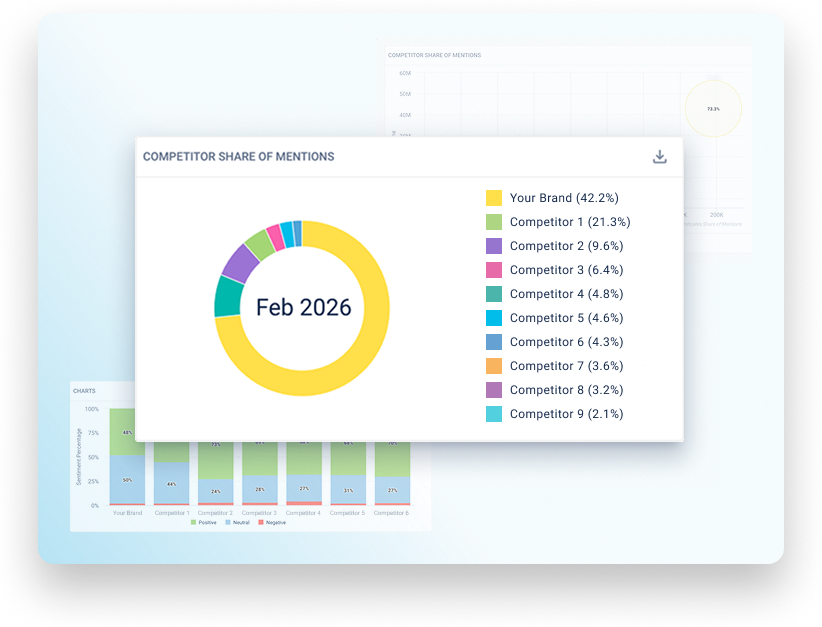
AI Hyper Cube reveals the AI Search conversations that matter most to your brand. It then tracks the competitive brands mentioned in those conversations, weighted by real search demand, so you get a reliable read on your competitive standing and early warning when that position starts to move.

2

Citation Tracking

Uncover Every Source AI Trusts in Your Brand Category 

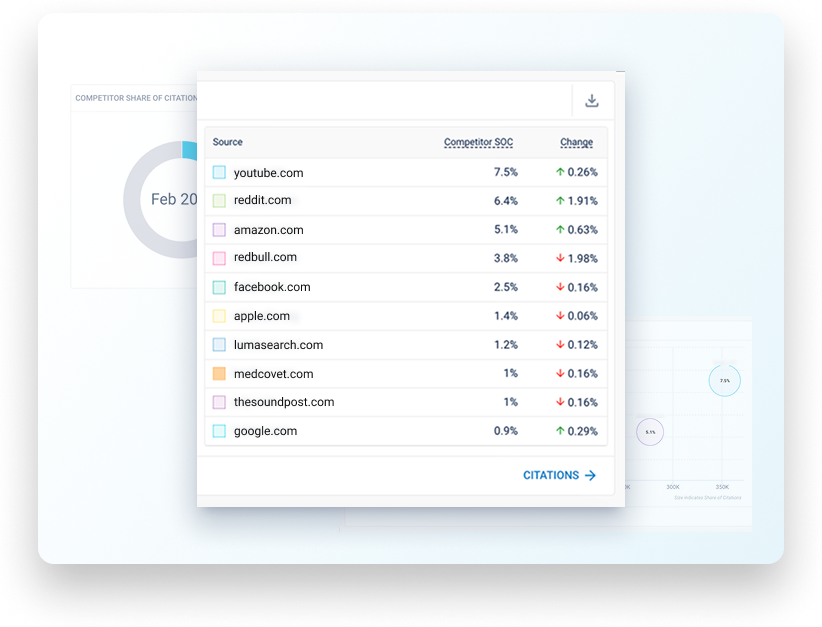
AI engines build answers from sources they trust. AI Hyper Cube shows which domains hold authority in your brand category, what earns that authority and how to increase your brand's presence in the sources AI trusts most.

3

Domain Research

Grow Your Brand Mentions from Pages AI Already Trusts 

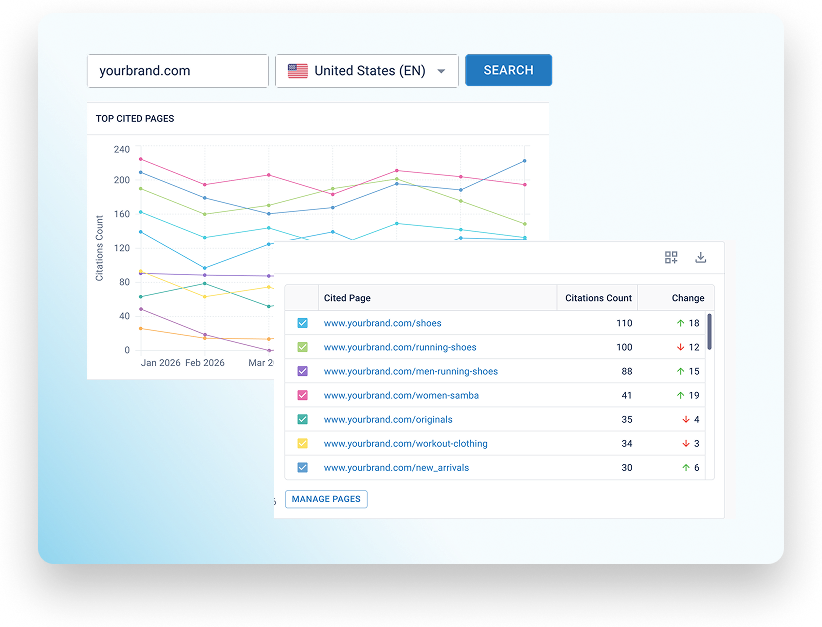
New brand mentions do not always require new content. Enter any domain, subdomain, directory, or URL and AI Hyper Cube shows every AI answer that cites it as a source. Filter to the pages AI already trusts where your brand is not mentioned, prioritize them by search volume, and update them to earn the mention they are missing.

4

Journey Mapping

Identify Where You Win and Lose Across the AI Journey 

AI answers shape what customers consider at every stage of the journey. AI Hyper Cube maps your brand's presence from early research to purchase intent, highlighting the moments you own and the ones competitors are capturing.

5

Content Intelligence

Create Content That Wins the AI Conversation

AI Hyper Cube identifies where competitors appear in AI answers and you don't. AI Catalyst and Content Advisor then turn those insights into action, giving your team clear content briefs, priorities and recommendations to create content that wins your brand a strong presence in AI-generated answers.

Ready to Take Your AI Search
Performance to the Next Level?

Whether you are just getting started with AI search or already optimizing for it, AI Hyper Cube and BrightEdge are ready to take you
further, see your position, outpace your competitors and act on every opportunity.

Request a Demo

,